Before the Podcast
By Junaid Ahmed
Nobody starts from zero.
That’s the thing I keep learning every time I go back and trace the thread. You think you started something — a podcast, a business, a creative practice — and then you follow the line backward and realize the roots go deeper than you ever talked about publicly. Way deeper. Into apartments in Riyadh, Saudi Arabia. Into a car trunk packed with VHS tapes. Into a fifteen-year-old kid watching his neighbor leave for vacation and thinking: that’s because they run a business.
This is the story I’ve never fully told. The one that happened before the blog, before the podcast, before any of it had a name.
A Neighbor Had a Business
I grew up in Riyadh, Saudi Arabia. My father had gotten a job opportunity there, and our whole family — eventually seven kids, my mom, my grandmother — made the move from Karachi, Pakistan.
One of our neighbors owned a business.
I was around seventeen — we had gotten our first computer in 1993 — and I was old enough to start noticing the patterns around me. What I understood was that they seemed to have more. More vacations. More music playing in the house. More of whatever freedom looked like to a kid watching from across the way.
I remember telling my dad once: “They have more time because they run a business.”
He didn’t disagree. He just kept working — because that’s what my father did. He worked his entire life. His own father had died when he was very young, leaving him, his mother, and a baby sister. He grew up fetching water in buckets every morning so they could wash. He clawed his way into a career as a systems analyst and programmer for mainframe computers at a national bank. He moved his family to Saudi Arabia for a better opportunity. He did not take shortcuts.
I watched all of that. I absorbed all of that. And somewhere underneath it, I also kept that first thought: the neighbor ran a business and had more freedom.
Both things became part of me.
The House Where Everything Got Figured Out
My mother was the other education.
Growing up in Riyadh, we didn’t have the internet. We had television, but it was only on from 5pm to 10pm, and then the TV crew just went home. If you needed to know how to do something — fix something, make something, build something — you either already knew or you figured it out.
My mother figured everything out.
I watched her set up a sewing machine and teach herself to sew. I watched her take a door off its hinges, lay it across the dining table, and trim the bottom with a jigsaw because it was dragging on the carpet. I watched her set up booths at school festivals — Pakistani Independence Day, August 14th — where we’d sell things we’d made or sourced. She got involved in every activity. She found a way.
I didn’t understand at the time that this was teaching me anything. I thought I was just watching my mom. But the thing that was getting installed was the belief that if a problem exists and you have the tools available, you solve it yourself. You don’t wait for someone to do it for you.
She learned it from her mother — my grandmother — who taught her to sew at a very young age. My maternal grandmother was one of 12 children herself, so figuring things out with what you had wasn’t a philosophy, it was just life. She was also a gardener, also a figure-it-outer. These things move through families like a current.
When I look at what I build now — the whole premise of PodGlue, the Home Studio Mastery content — it’s the same impulse. There’s a problem in front of me and I can see the shape of the solution. Let me just build it.
That started in Riyadh. In a third-floor apartment. Watching my mom and a jigsaw.
The Deal I Made to Come to America
My mother’s siblings had all migrated to the United States. My great uncle went in the 1960s. Her oldest brother came in the 1970s and started filing petitions so the rest of the family could follow. We visited in 1985 — a summer vacation I still half-remember in flashes: a huge passenger van, Yosemite National Park, homogenized American milk that did not agree with me, cousins I immediately didn’t want to leave.
I was nine. I went back to Riyadh and cried.
By my mid-teens, I had two options: go to Pakistan for university, or find a way to the United States. Pakistan’s education system at that time was broken. The answer was obvious. But my father had one condition.
I had to read the entire Quran — in Arabic and in Urdu translation, side by side, front to back.
I had read it in Arabic many times. That wasn’t the point. He wanted the translation. He wanted me to understand what I was reciting, not just recite it. The page on the left in Arabic, the page on the right in Urdu. Cover to cover.
So I read it. By the time I finished, our green cards had come through.
We arrived in the United States in 1995. I was nineteen years old and I had an Islamic education, a father’s work ethic, a mother’s DIY instinct, and approximately zero knowledge of how anything in America actually worked.
That was fine. I was ready to learn.
The Car Trunk Full of Books
My first job in the US was data entry at a place that put tracking chips in animals. I discovered I was allergic to cats. I filed that information away and moved on.
My second job was cold calling at SoundVision — a Muslim company that sold Islamic books, videotapes, and educational materials by catalog. I was signing people up for subscriptions. One time I accidentally called the president of the company because his number was listed under two different names. His son and I are friends now.
But the job that actually woke something up came through my uncle.
He was a businessman — import-export, always moving, always selling. When I told my manager at SoundVision about him, something clicked. The manager said: I can get you all of this inventory on consignment. Islamic books, VHS tapes, CDs, educational materials. You take them to the mosque on Fridays, set up a table, and you keep a margin on whatever you sell.
My uncle was immediately in.
And so every Friday, my car trunk was packed with merchandise. We’d set up a table in front of the mosque. People would stop after Jumu’ah prayer and browse. I was talking to people, making change, figuring out what sold and what didn’t. I was nineteen.
Nobody called it entrepreneurship. We just called it hustling. But I was learning the mechanics of finding a product, finding an audience, showing up consistently, and building trust with people who would come back the following week.
Around the same time, I was designing flyers for the booth in Microsoft Word. Printing them. Distributing them. I was doing the marketing because I knew how to use the computer. My dad had been a programmer — we got our first computer in 1993, a 486 chip — and I’d spent two years watching him type without looking at the keyboard, completely fluent, utterly focused. I wanted to do that. And now I could. So I built the flyers.
The seed was in. I just didn’t know what was growing yet.
humblezone.com: February 1, 2000
Between the mosque booth and the year 2000, I did a lot of things at once.
I worked at a community college writing center (my first encounter with a Mac). I worked at a computer assembly shop, where I memorized Windows 98 license codes while building machines. I worked at Island Breeze, a small web hosting company where I was the only web designer and the owner taught me everything about DNS, static IPs, and running a rack of Windows servers.
I was always working. Always learning. Moving from place to place, picking up skills, leaving with more than I arrived with.
On February 1, 2000, I registered humblezone.com.
It was a placeholder for something I didn’t know how to name yet. A claim. A flag in the ground that said: I’m going to build something. I don’t know exactly what it is, but I’m saving the spot.
It would take another four years before I started blogging. Another eighteen before I fully understood what the research operation was actually producing.
But the domain was registered. The decision was made.
What I Know Now
There’s a version of the Hacks and Hobbies origin story that starts in 2018, when I recorded the pilot episode. That version is technically accurate and almost completely wrong.
The real origin story starts with a neighbor who ran a business and always had more vacation. It runs through a mother who trimmed doors with jigsaws and never waited for someone else to solve a problem. It passes through a 1995 arrival in a country where I knew nobody, spoke English unevenly, and had to build everything from scratch.
The mosque booth taught me to show up. The flyer design taught me marketing. Island Breeze taught me web infrastructure. Watching my father type taught me what fluency looks like. Reading the Quran cover-to-cover before getting my green card taught me that commitments have weight.
Every episode of Hacks and Hobbies, every discovery call, every Saturday morning studio consultation — it all came from that foundation. I was always going to end up here. I just had to travel the whole distance to see it.
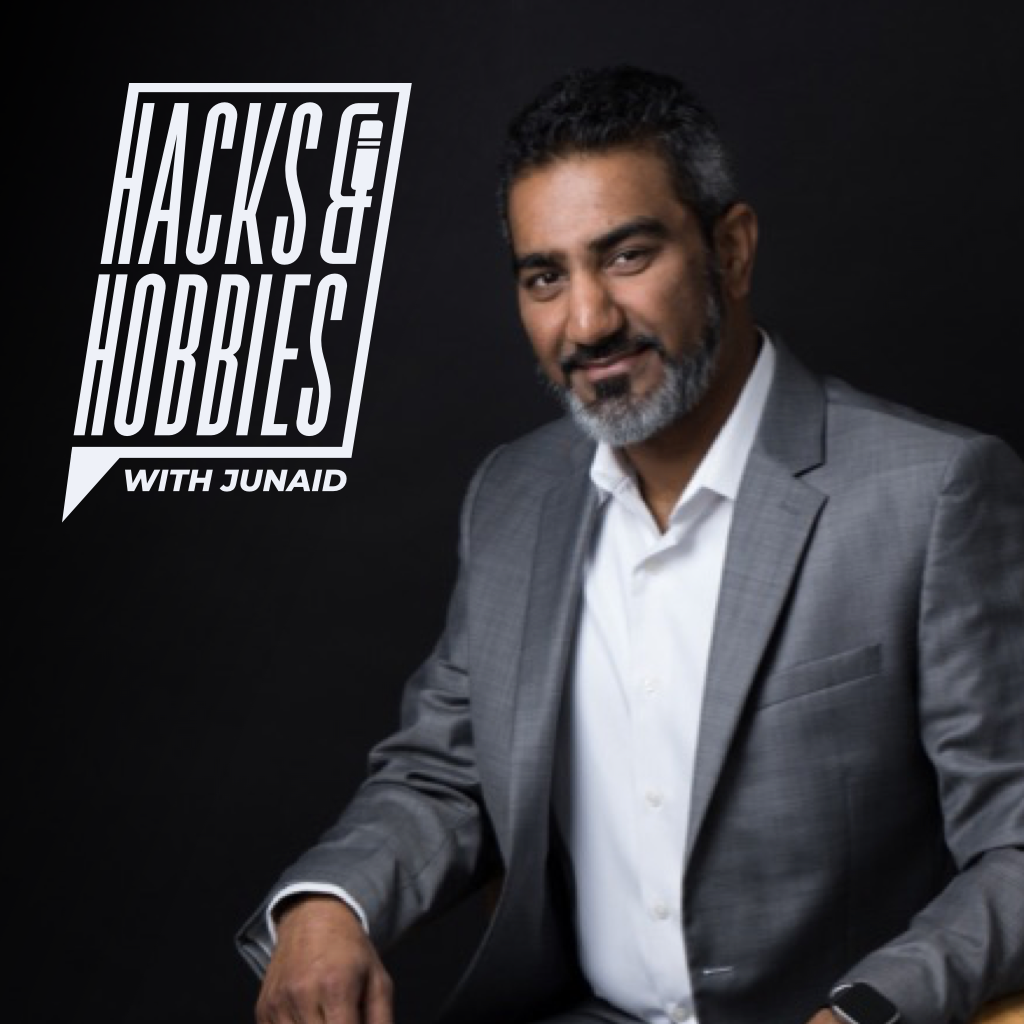
Junaid Ahmed is the host of Hacks and Hobbies and the founder of PodGlue. He grew up in Riyadh, arrived in the US in 1995, and has been building things ever since.

Junaid Ahmed is a multi-passionate creator, storyteller, and home studio architect who believes your voice can change your world. As the host of Hacks and Hobbies, he dives deep into the journeys of people turning passion into purpose — from garage inventors to global entrepreneurs.
The podcast began as a simple idea: record honest conversations about side projects, creativity, and the hustle behind the scenes. Years later, it’s become a movement — showcasing the real, raw, and inspiring stories of everyday innovators.
Whether he’s building pro-level studios or geeking out over podcast gear, Junaid’s mission is clear: help people show up with confidence, clarity, and character.
🎧 New episodes weekdays. New perspectives in every story.